Discovering Concept-ready Insights in 2 weeks: Yasna Method
How our discovery methodology maps uncertainty, finds territories for NPD, and validates insights – all in 14 days.

Similar cases:
Are Market Researchers Allergic to AI?Consumer Insights About Sex ToysConversational Research EvolutionEarly stage discovery and ideation is the phase of NPD, where teams operate under uncertainty: there are many possible directions, limited clarity on what will truly resonate, and a high risk of costly mistakes later.
At Yasna we developed a methodology, supported by AI research tool and human experts in the loop, that allows teams to move efficiently from uncertainty to a list of validated insights quickly, cost-effectively, and without complexity.
To illustrate how this methodology works in practice, here is a description of a project that we had done together with one of our clients in the dairy category on workout occasions.
The business challenge: starting discovery in a high-growth category
The high-protein product category is showing strong growth momentum, driven by the shift toward functional nutrition and active lifestyles. The category is still evolving, which creates significant whitespace for innovation. But capturing that opportunity requires a deep, evidence-based understanding of real consumer behaviors and unmet needs.
Our client’s R&D team wanted deeper insight into high-protein product consumption in workout occasions to uncover opportunities for new product solutions for moments before, during, and after sports.
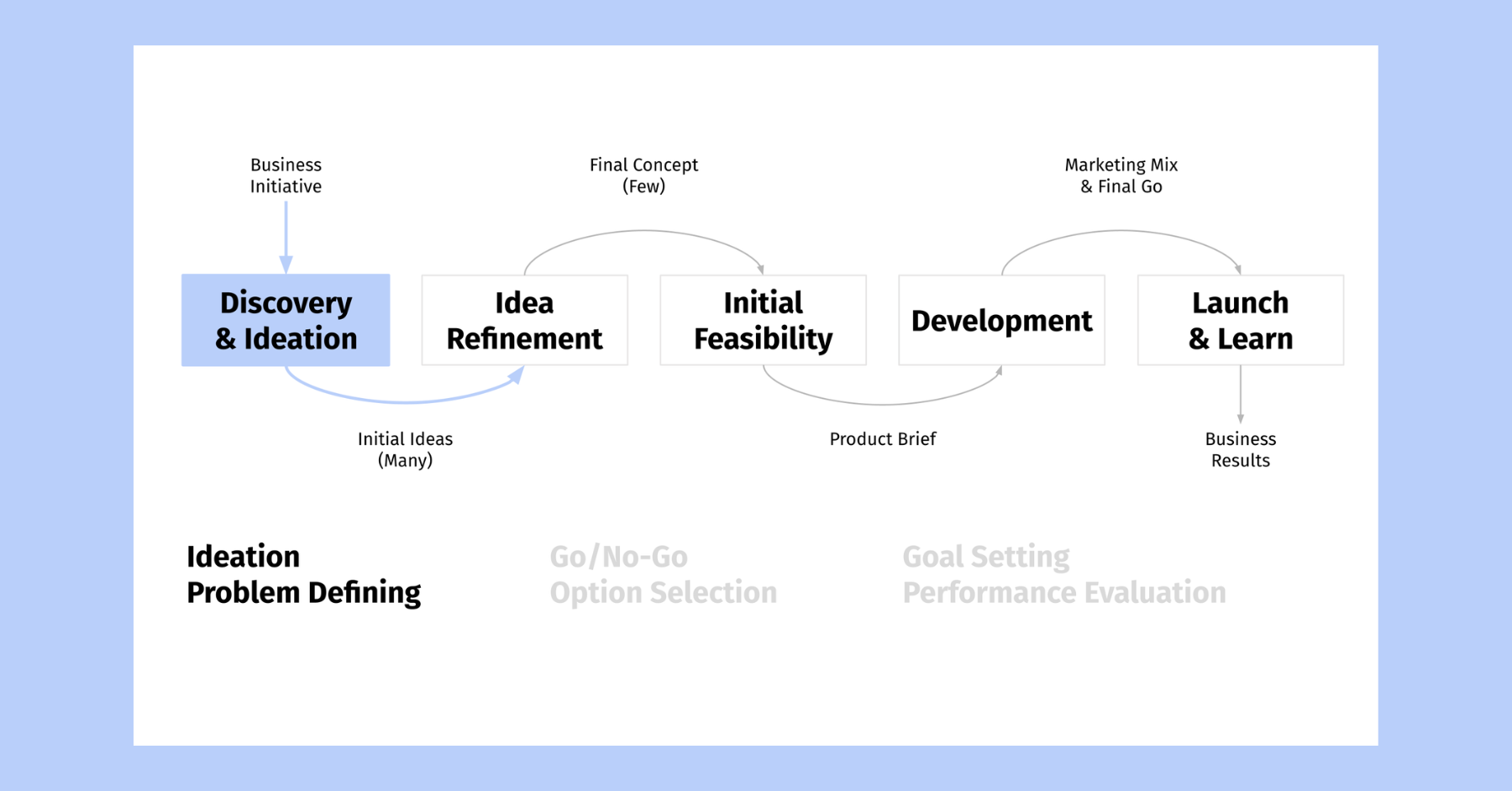
Discovery & Ideation are the most crucial stages in NPD, as they lay the foundation for future product success.
Discovery and ideation are the most critical stages of the new product development process. This is where a product’s future is often determined: whether it becomes a category breakthrough or just another SKU that disappears from shelves after a few months. The foundation is laid here.
But despite its importance, this stage is highly complex. Researchers must work across multiple information sources, many stakeholders, a changing consumer environment, and practical research constraints. Teams can quickly become overwhelmed, which often leads to generic concepts – or to mistakes being discovered only later, when the cost of correction is much higher.
This is also where common research setups often fail: traditional qualitative research can be too slow and fragmented for iterative discovery, while quantitative methods alone are too shallow to uncover the tensions behind behavior. AI-only approaches may add speed, but they often avoid responsibility for meaning and recommendations.
Research objectives
Our goal was to explore consumers’ habits and attitudes across key workout moments: how they choose and use high-protein products, what pain points they experience, what drives satisfaction, where doubts appear, and what builds loyalty.
The client – an established dairy brand – expected a set of well-defined, evidence-backed, and clearly illustrated insights with strong potential for new product solutions. The only input was the business challenge above, along with a familiar reality for many research teams: previous agency approaches and methods had not delivered a satisfactory outcome.
Our approach: a proprietary iterative framework to discovery
Our methodology is straightforward: it begins with broad category exploration, moves into insight generation, and then uses quantitative validation to identify the strongest opportunities.
What makes our approach different is that our research product – combining methodology and human expertise – is supported by an AI-powered research platform. This makes the process faster, more iterative, and enables qualitative and quantitative approaches to work within one continuous workflow.
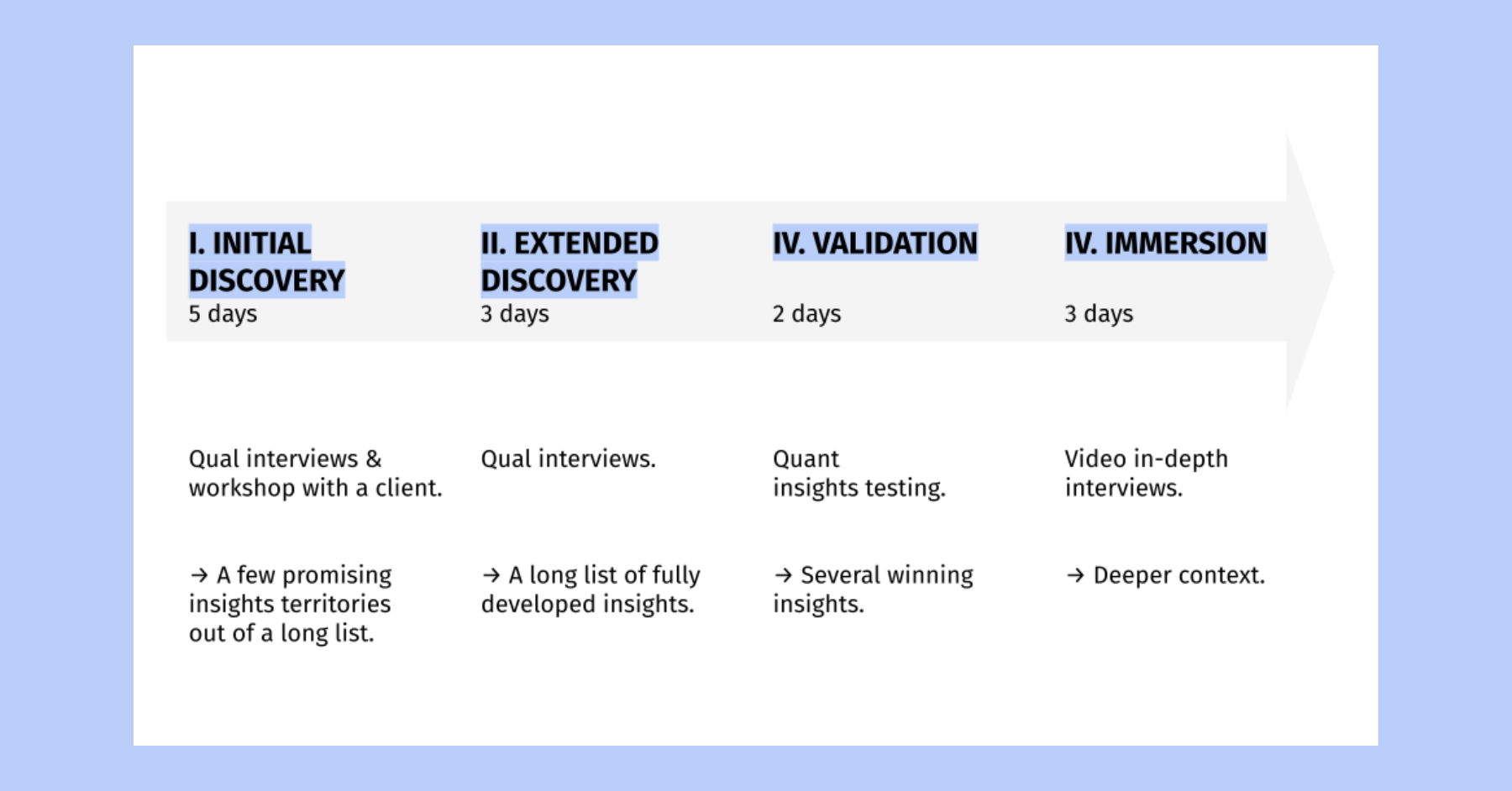
Yasna’s proprietary iterative framework to discovery.
We combine AI automation where speed, consistency, and scale matter most with human experts where interpretation, judgment, and responsibility are critical. AI supports fieldwork execution and analysis workflows, while Yasna’s research team leads study design, interprets the findings, and takes ownership of the final recommendations.
For this project, we interviewed men and women aged 18–65 in France and the UK who exercise at least twice a week and are mindful of their nutrition. Using the Yasna.ai platform, we conducted automated research in text, voice, and video formats, combining conversational qualitative research with quantitative surveys in one workflow.
Research Design Specifications
| Stage 1. Initial Discovery | 100 automated interviews, followed by a joint prioritization workshop with the client. | 5 days |
| Stage 2. Extended Discovery | 100 automated interviews across 4 selected territories. | 3 days |
| Stage 3. Validation of Insights | 400 quantitative interviews across 20 insights. | 2 days |
| Stage 4. Immersion | 50 automated text and video interviews across 5 top insights. | 3 days |
Why does this approach work? Early-stage innovation requires both speed and judgment. Yasna’s iterative framework combines AI-enabled scale in qualitative fieldwork with human-led interpretation and decision support, then adds quantitative validation to build confidence before concept development.
Stage 1: Discovering and selection of insight territories
In the first stage, we ran a broad exploration of potential insight territories through 100 in-depth interviews across two countries. Respondents interacted with our AI moderator in a conversational chat format, which allowed them to express their thoughts naturally and in detail.
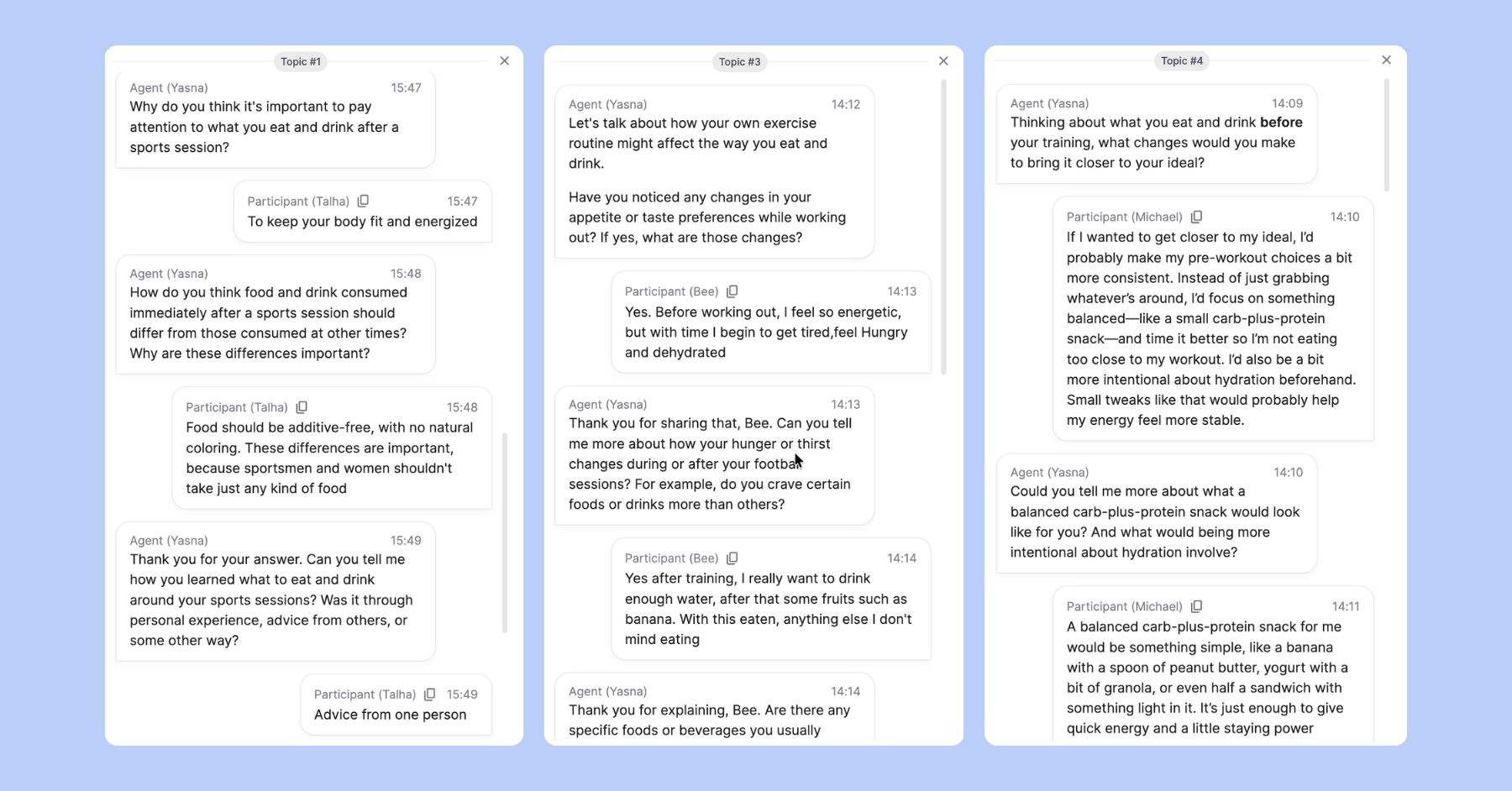
Yasna’s AI moderator runs natural conversations to explore consumer habits and attitudes.
This stage produced a long list of potential insight territories. We found that health and wellness have become fully mainstream: gyms are crowded, fitness apps are booming, and “healthy lifestyle” behavior is now a social norm rather than a niche. But beneath that enthusiasm lies a quiet contradiction: many people actively follow wellness trends without feeling confident in the practical side of what to eat and drink around training. We call them “normies” – motivated, disciplined consumers trying to do things right, but lacking clear guidance.
“Between meals on training days, hunger spikes quickly, and I fight not to snack on ultra-processed foods. After training I risk raiding the fridge because I’m ravenous. So I want a recovery ritual that curbs cravings.” – Female, 27, UK
This early stage was especially valuable because it surfaced blind spots that would have been easy to miss in a survey-first approach – not just what people do, but where they feel uncertainty, tension, and lack of confidence in their routines. Conventional qualitative research could also uncover this depth, but typically not at the same speed or iteration pace.
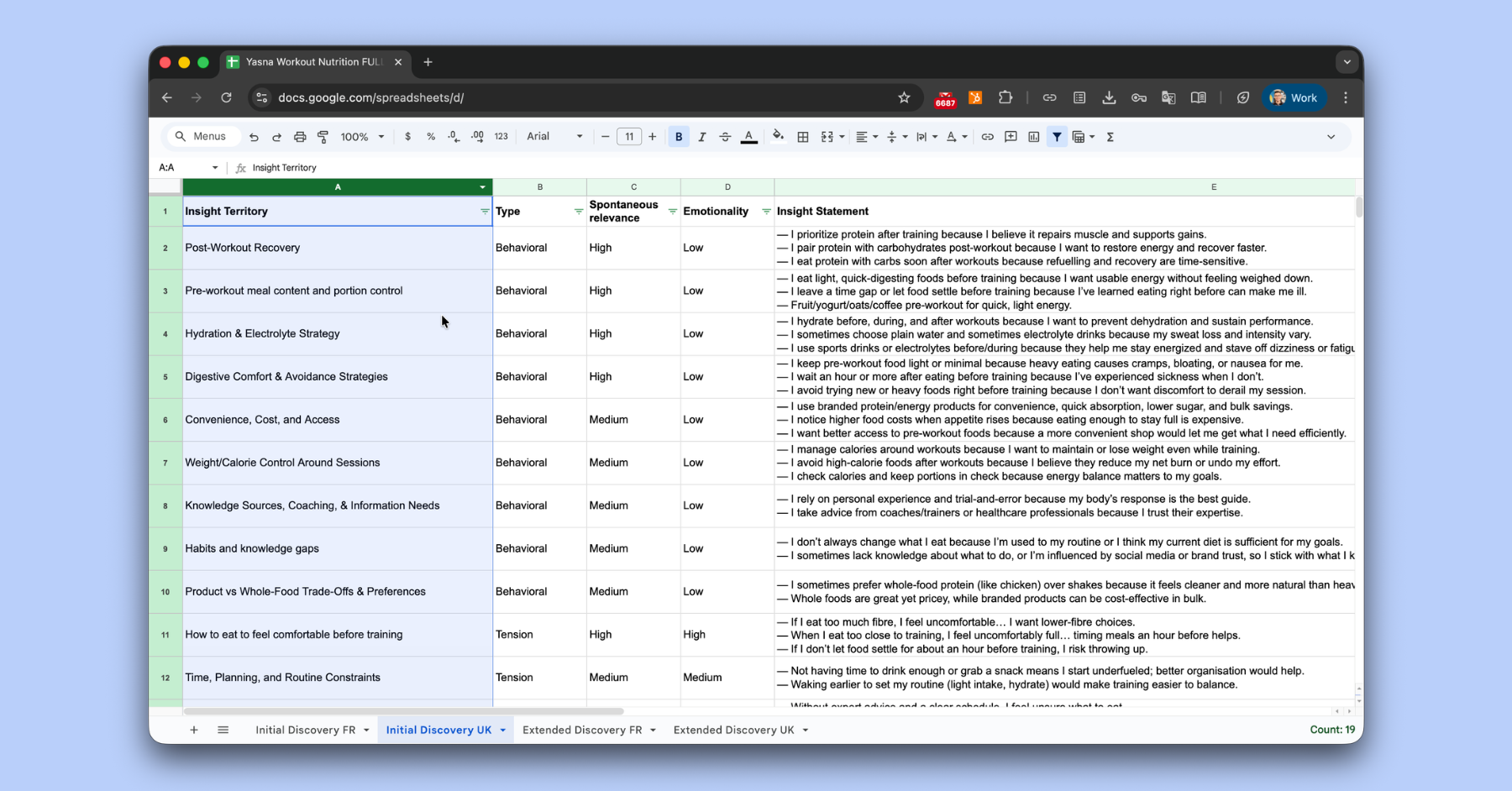
Stage 1 output: a broad map of insight territories for the next waves of insight development.
After the initial exploration, we ran a workshop with the client to review the identified territories and agree on the way forward. The core tension we uncovered – confusion around eating and drinking in workout routines – pointed to two promising product development routes: one focused more on beverages and hydration, and another centered on nutrition.
This is where human judgment becomes essential: together with the client, our researchers translated broad signals into clear, business-relevant territories for the next iteration.
Stage 2: Extended discovery – deep diving into confusion
We then moved into extended discovery to prioritize, size, and explain more detailed insights, and to recommend concrete product development scenarios.
To do that, we conducted another 100 automated in-depth interviews across two countries. Thanks to our AI research platform, this stage was completed in just 3 days.
The key revealed tension was confusion related with hydration and nutritioning during workout occasions.
Confusion was especially visible in hydration. Many people struggle in basic, almost universal physiological ways. Some drink too much water before training, believing “more is better,” and then have to interrupt workouts repeatedly. Others, fearing this exact problem – or simply forgetting – drink too little, and feel weak, dizzy, or unfocused during training.
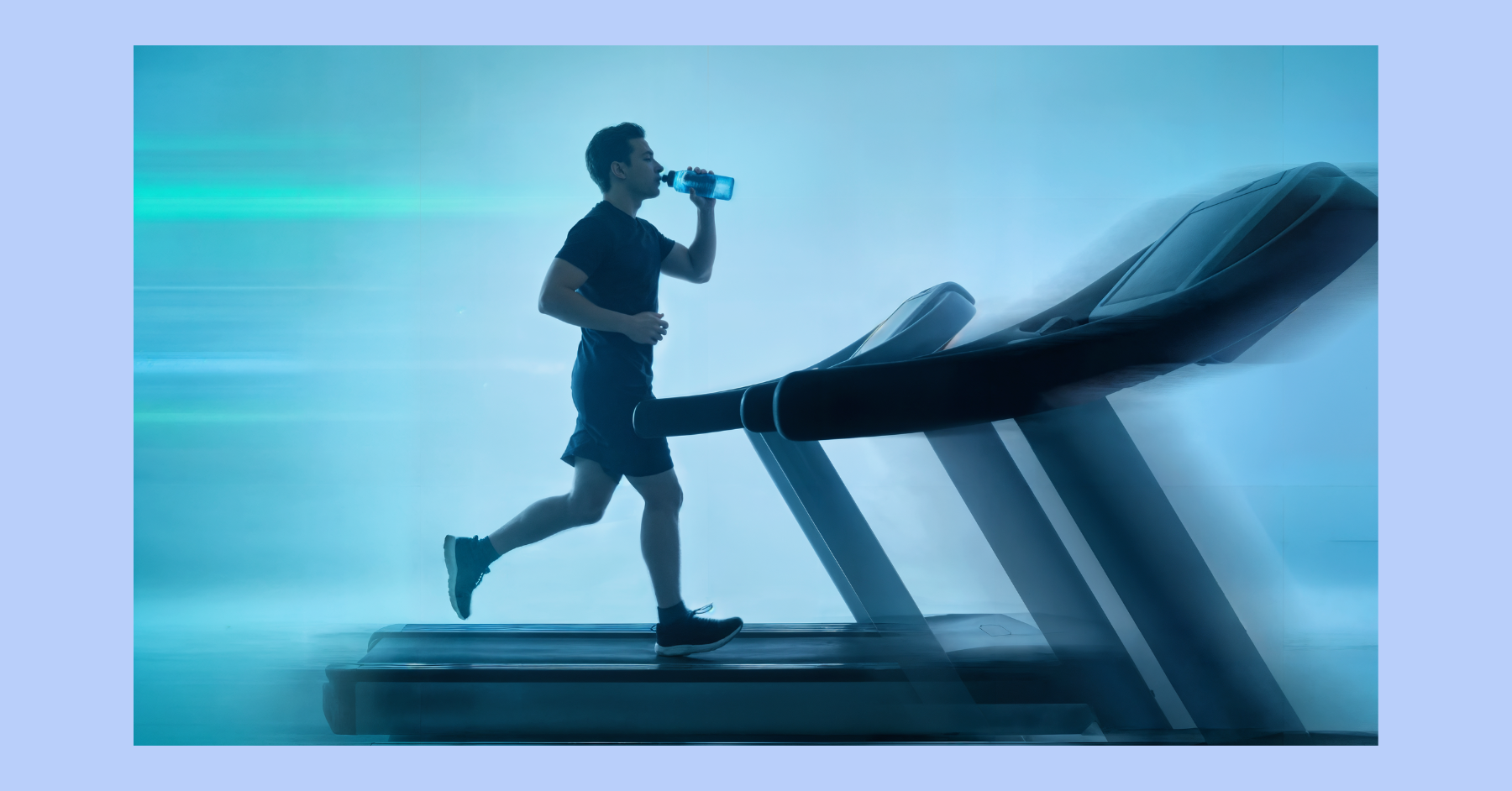
“On busy days I forget to drink or leave my bottle behind and come back feeling really rough with a dry mouth. I want prompts and a portable bottle so I can sip even when juggling kids or work.” – Male, 42, UK.
Nutrition before and after training revealed an even deeper layer of confusion. People know they are not eating as well as they should – especially in relation to protein – and that awareness itself becomes a source of stress. Some eat too much before a workout and feel heavy. Others overeat after training and feel they have “undone” their effort. Many try sports nutrition products but consume them with anxiety, worrying they are not natural.
Perhaps the most paralyzing issue, however, is informational overload. People are surrounded by endless, contradictory advice from bloggers, influencers, and self-proclaimed experts. That abundance leaves them confused and insecure. At the same time, our previous research suggested that one of the most trusted sources on hydration and nutrition is the manufacturer itself – which creates a clear opportunity for product-led guidance.
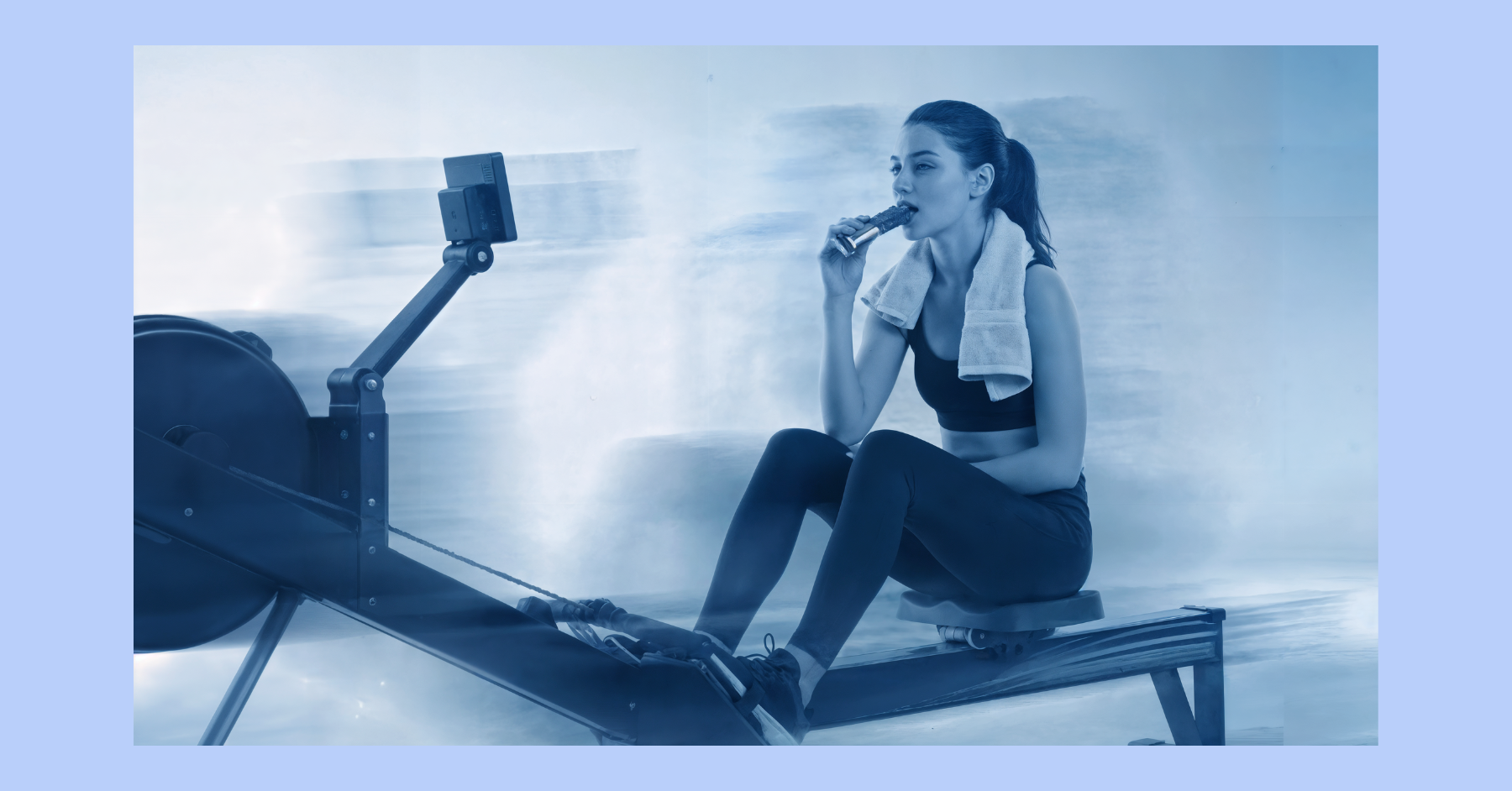
“If I don’t get enough protein I feel sluggish and recover slowly, but I don’t want to overeat. I want filling, high-protein options that keep calories under control.” – Female, 35, France.
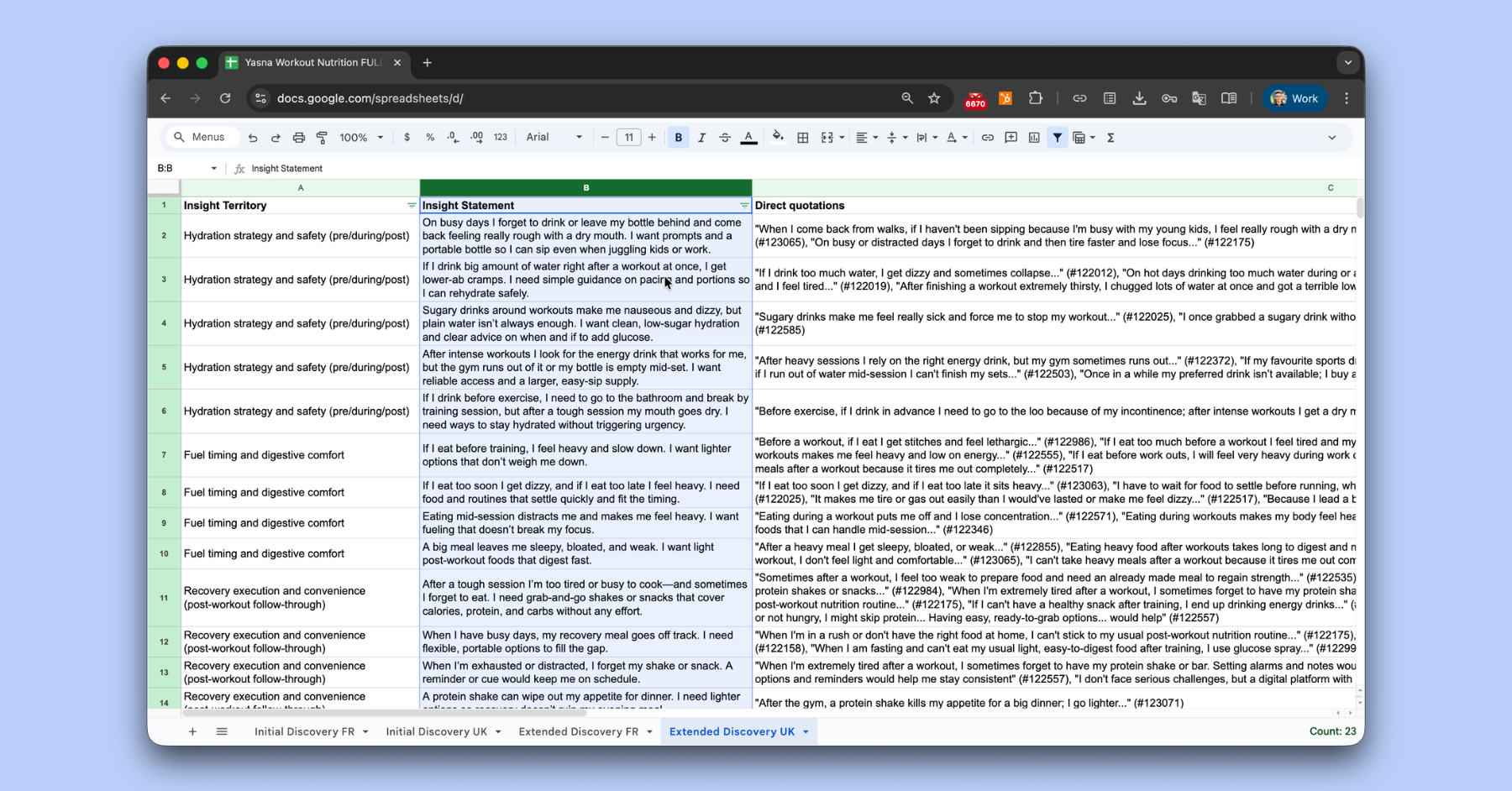
A long list of insights ready for quantitative validation.
By the end of Stage 3, our team has developed 22 fully formed insights ready for validation.
Stage 3. Quant validation of insights
The next step in our Discovery framework was quantitative testing of the 22 insights identified in Stage 3. The goal was to ensure that the insights selected for further product development were both relevant and perceived as new by the target audience.
This step was not a separate track, but a continuation of the same discovery logic: qualitative work uncovered the tensions and insight language, while quantitative validation helped prioritize what was strongest, most relevant, and most scalable. In other words, we moved from qualitative depth to decision confidence.
We conducted 400 quantitative interviews across two countries. Thanks to automation in sampling, fieldwork, and analysis, this stage took only 2 days.
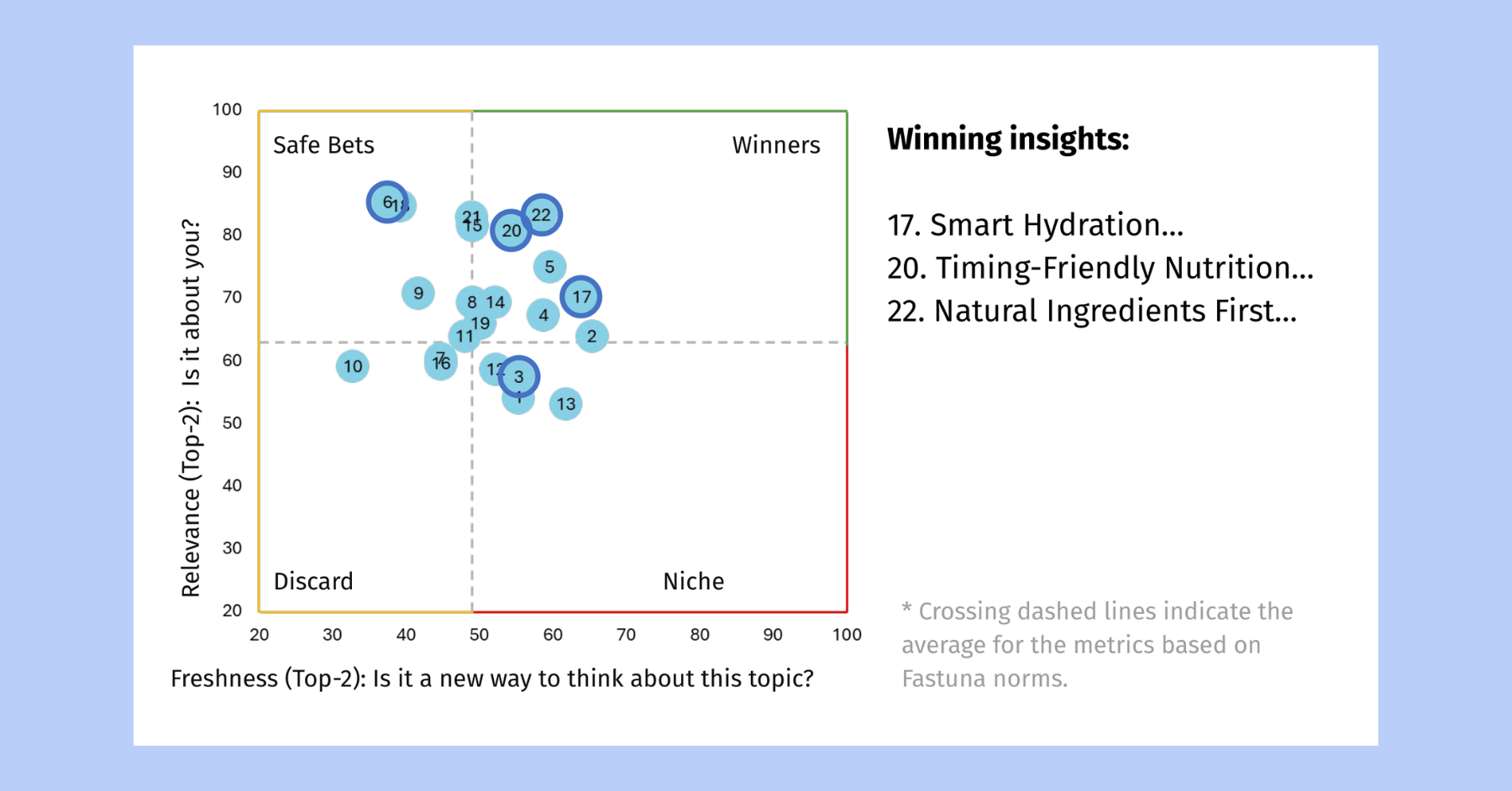
Based on our benchmarks we evaluated insights and chose a few winning ones out of a long list discovered at the previous stage
After quantitative evaluation we recommended three product development routes built around the strongest insights linked to confusion in hydration and nutrition.
Recommended product routes:
Smart Hydration. Develop a low-sugar, engaging drink that supports hydration without causing nausea or bathroom interruptions.
Timing-Friendly Nutrition + Built-In Guidance. Create products clearly designed for before, during, or after training to prevent overeating and discomfort — and include simple on-pack guidance (what to consume, when, and how much) to cut through information overload.
Natural Ingredients First. Prioritize clean, familiar ingredients to reduce fear of “chemicals” in products for workout occasions.
Stage 4. Immersion into consumer stories
By the last stage, the core job was already done: the key insights had been developed and validated. But a list of insights alone is not always enough for R&D, marketing, and other client stakeholders to fully understand and feel the consumer reality behind them.
Using Yasna’s video interview capability, we conducted an additional round of interviews and delivered a reel of consumer videos showing routines, habits, pain points, and attitudes toward protein consumption in workout occasions.
Project outcome. From uncertainty to actionable product routes in 14 days
As a result of this approach, the client moved from a broad business objective to fully developed, tested, and illustrated insights in just 14 days – ready for concept development.
More importantly, the team gained reliable early-stage clarity under uncertainty: a prioritized set of insight territories, validated product routes, and a stronger basis for decision-making. This reduced the risk of late-stage failure and helped focus resources on the opportunities with the highest potential.
This structured journey – from broad uncertainty to specific, validated recommendations – demonstrates how Yasna’s methodology provides clarity and direction for successful innovation in evolving categories.
Want to learn how we can support your NPD discovery stage? Book a call with us at yasna.ai/demo
Continue reading
Top picks about AI-powered interviewing
Yasna Updates Reporting Feature
Create customized reports by asking simple questions, simplifying data analysis and merging insights.

Yasna Unveils Screening Feature
For Enhanced Respondent Experience and Data Quality Assurance

Yasna.ai Introduces AI Moderator 2.0
Smarter, More Culturally Aware, and Autonomous